
Menopause Weight Gain: Why It Happens and What Actually Helps
Updated June 2026
If you are in your 40s or 50s and feeling panicked about what is happening to your body, the weight that won’t budge, the belly that wasn’t there before, you are not alone. I hear this from my patients every single day. And as a registered dietitian who has been through it herself, I get it more than most.
You are eating well. You are moving your body. And the weight is still going up. That is one of the most frustrating things a woman can experience, especially when you are doing everything right.
Here is what I want you to know: it is not you. It is your hormones. And this often starts earlier than most people realize. Perimenopause, the transition leading up to menopause, can begin up to 10 years before your last period. So if you are in your early 40s and already noticing changes in your body, that is why.
Once you understand what is actually happening, you can start making changes that work. Let me walk you through the real reasons behind menopause weight gain and what actually helps.
Why Is Menopause Weight Gain Different?
This is not the same as gaining weight in your 20s or 30s. During menopause, multiple things happen at once. Your hormones shift, your metabolism slows, your sleep gets disrupted, and your body starts storing fat in new places. That is why the same diet and exercise routine that kept you at a healthy weight before may not work anymore.
The good news: understanding the causes gives you real options. Here is what is driving it.
10 Causes of Weight Gain During Menopause
Hormonal Changes
Estrogen does a lot more than most people realize. It helps regulate your metabolism, control where your body stores fat, maintain muscle mass, support insulin sensitivity, and even manage your appetite.
During perimenopause, estrogen does not just decline. It fluctuates wildly. This is why this phase feels so unpredictable. Then, at menopause, there is a definitive decline. And it is not a quick drop. This process takes years.
As estrogen falls, your metabolism slows, your body stores more fat around the belly, and your muscles become harder to maintain. Unfortunately, there is nothing we can do to stop that from happening. But you can control how your body responds through healthy eating, strength training, better sleep, and managing stress.
Muscle Loss
Muscle loss starts as early as your 30s and continues at a rate of 3 to 5% per decade. Menopause speeds this up by shifting your body composition toward more fat and less muscle. Why does this matter? Because muscle burns more calories than fat, even at rest. The less muscle you have, the fewer calories your body needs. That means eating the same amount as before can still lead to weight gain.
What helps: Strength training is one of the most powerful tools you have during menopause. Aim for two to three sessions per week and make sure you are eating enough protein, at least 25 to 30 grams per meal, to support your muscles.
Insulin Resistance
One of estrogen’s important jobs is helping your body respond to insulin. As estrogen drops, insulin resistance can develop. This means your body needs more insulin to process carbohydrates, and higher insulin levels promote fat storage.
What helps: Choose carbohydrates that are high in fiber, reduce added sugar, and spread your carbs evenly throughout the day. Pair carbs with protein and fiber at every meal. Try eating your vegetables and protein before your carbohydrates. And move your body after meals, whether that is a workout or a short walk. All of these things help your body respond to insulin better.
Changes in Activity Levels
Life gets busy. Between work, kids, aging parents, and everything else, exercise often takes a back seat. Many women also shift toward walking as their main form of exercise, which is great, but it may not be enough on its own to maintain muscle mass and metabolic health during menopause.
What helps: Prioritize yourself. You will be a better mom, friend, daughter, and wife when you do. Aim for at least 150 minutes of moderate activity per week, with a mix of cardio and strength training. Strength training is especially important during menopause. It protects your muscle mass and keeps your metabolism working for you.
Changes in Eating and Drinking Habits
Small changes in eating habits add up over time. An extra glass of wine a few nights a week, slightly larger portions, and more frequent snacking. These are easy to miss but can lead to real weight gain over months and years.
It helps to take an honest look at what has changed, not to judge yourself, but to find where small adjustments can make a big difference.
Poor Sleep
Menopause disrupts sleep in multiple ways. Night sweats, anxiety, and hormonal shifts all interfere with rest. And poor sleep makes weight management much harder.

When you are sleep deprived, your hunger hormone ghrelin goes up, and your fullness hormone leptin goes down. You feel hungrier and crave high-calorie foods. Poor sleep also raises cortisol, which drives fat storage around the belly.
What helps: Treat sleep like a non-negotiable part of your health. Consistent bedtimes, a cool, dark room, and limiting alcohol and screens before bed all make a difference. If sleep disruptions are severe, talk to your doctor. Hormone replacement therapy and other medical options may help address the root cause.
Read more about how sleep impacts weight.
Stress, Anxiety, and Mood Changes
Midlife brings real stressors, and menopause adds hormonal mood swings on top of that. Anxiety, depression, and emotional volatility are common during this time. These are not just emotional struggles. They have a direct impact on your weight. Depression and anxiety can make it harder to exercise and sleep, lead to stress eating, and trigger hormonal changes that make weight gain worse.
What helps: Your mental health matters just as much as your meal plan. Exercise is one of the best tools you have. It improves mood, reduces anxiety, and helps regulate hormones. Mindfulness, therapy, and leaning on a support system also help. If you are feeling overwhelmed, please reach out to your doctor. You do not have to navigate this alone.
Gut Health Changes
Research shows that menopause affects the gut microbiome. An imbalanced gut can contribute to more fat storage, a slower metabolism, and increased insulin resistance. This is still an emerging area of research, but one thing is already clear: gut health and hormonal health are deeply connected.
What helps: Eat a variety of fiber-rich foods, including fermented foods like yogurt and kefir, and reduce ultra-processed foods. These simple changes can go a long way in supporting a healthier gut.
Read: Lose Menopause Weight By Healing Your Gut
Inflammation
The transition to menopause increases inflammation in the body. When inflammation becomes chronic, it slows your metabolism, increases hunger, and makes insulin resistance worse. And here is the frustrating part: weight gain causes more inflammation, and more inflammation causes more weight gain. It is a cycle that is hard to break.
What helps: Follow an anti-inflammatory diet. Fill your plate with vegetables, fruits, whole grains, and healthy fats. Include omega-3-rich foods like salmon, walnuts, and flaxseed regularly.
Helpful blogs:
Anti-inflammatory diet for menopause
A Slower Overall Metabolism
All of the above, muscle loss, hormonal changes, poor sleep, and insulin resistance, add up to a slower metabolism. Your body simply burns fewer calories than it did in your 30s. This is not a personal failure. It is biology. And understanding that is actually the first step toward doing something about it.
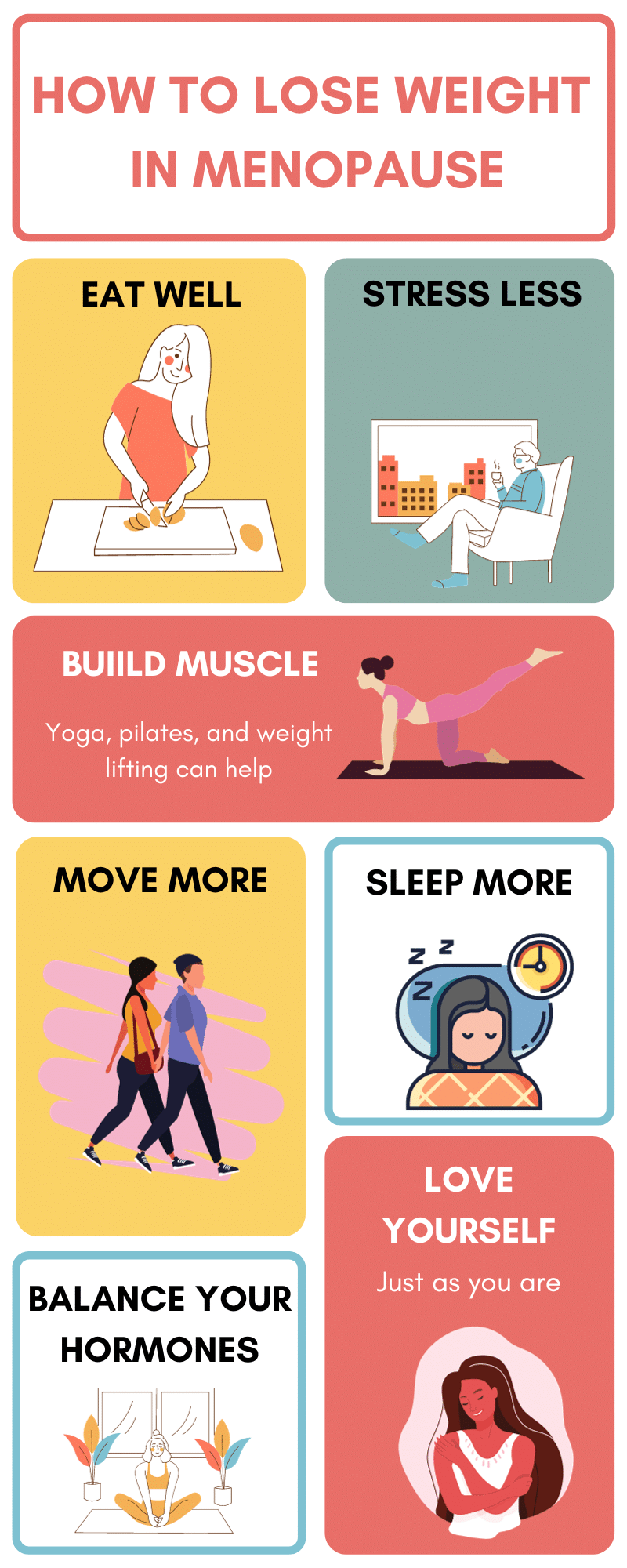
How to Lose Weight in Menopause
Here is what I tell every patient who comes to me with this exact struggle: there is no single fix. But there is a clear path forward.
And here is the most important thing I want you to hear: you do not have to do everything at once. Pick one or two things from this list, focus on those, and once they feel manageable, add the next. Small, consistent changes beat a perfect plan you can not sustain.
Start with food quality, not restriction. No single food group is the enemy. Focus on protein at every meal, choose high-fiber carbohydrates, include healthy fats, and reduce added sugar and ultra-processed foods. Balance is what makes this work in the long term.
Protect your muscles. Strength train two to three times per week and eat at least 25 to 30 grams of protein per meal. This is non-negotiable during menopause.
Work with your hormones, not against them. Manage blood sugar by pairing carbs with protein and fat, eating evenly throughout the day, and moving your body after meals. Prioritize sleep. Find a way to manage stress that actually works for you.
And do not forget about your gut and inflammation. They are quietly driving a lot of what you are experiencing.
Finally, know that what works for one woman may not work for another. Some of my patients need to focus on insulin resistance first. Others need to fix their sleep before anything else clicks. If you have been struggling despite doing all the right things, it may be time to get personalized support. A registered dietitian can help you figure out exactly where to focus. And if diet and lifestyle changes are not enough, talk to your doctor about whether GLP-1 medications might be right for you.
Helpful reads:
A Note From Me
When I work with women going through menopause, I never start with just a meal plan. I ask about sleep. I ask about stress. I ask what their daily routine actually looks like, because all of those things drive weight during this phase of life just as much as food does.
The women I see who make the most progress are the ones who stop fighting their bodies and start working with them. More protein, more strength training, better sleep, less sugar, and real support for stress.
You are not broken. Your body is not betraying you. It is changing. And with the right approach, you can feel strong, healthy, and like yourself again.
You’ve got this.
Ready for personalized support? I would love to help. Book a session with me.

Dr. Su-Nui Escobar, a Registered Dietitian/Nutritionist in Miami, FL, is dedicated to empowering women in perimenopause and menopause to live healthier, more satisfying lives.
With a doctorate in clinical nutrition from the University of North Florida, she has expertise in menopause and weight loss, including the unique challenges faced by those on weight loss medications.
Su-Nui’s passion for her field is evident in her previous role as the Academy of Nutrition and Dietetics spokesperson.